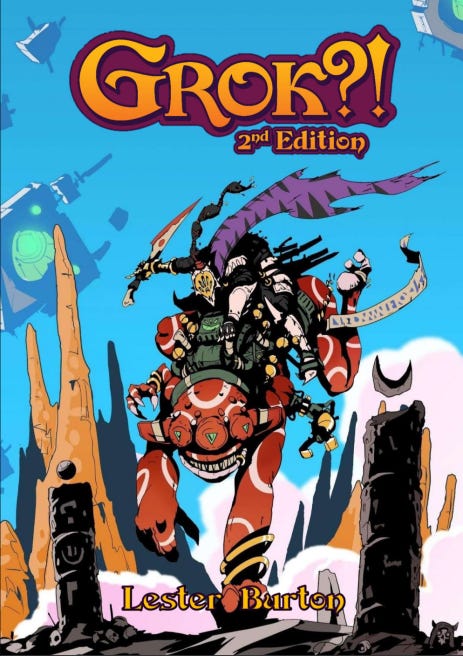
GROK?! 2E: A Gonzo Science Fantasy RPG
We talked to Lester Burton about the new edition of his game!

Mario | La Esquina del Rol Games: Lester Burton, welcome to La Esquina del Rol Games. It’s a pleasure to chat with you about the hobby and, of course, about Grok!? A few days ago, I told Alan Bahr how happy I was to finally work up the courage to write to you and propose this interview, and he mentioned that you two are very good friends. Haha, the tabletop RPG world is a small world indeed!
Lester, could you introduce yourself to our community and tell us who you are and how you got started in role-playing games?
Lester Burton | gandergaming.com: Thanks, Mario - I'm really excited to chat with you! Alan's awesome and a constant source of inspiration. You're right that it's a small (RPG) world haha I'm an indie RPG designer/writer, and do some freelance writing/editing when I can. My most noteworthy work has been Grok?! - a gonzo science-fantasy game built on its own system. I got my start in RPGs reading through my older brother's D&D 3.0 books when I was about 12. I loved poring over those books and writing characters I'd never play. My first "real" game was when my brother invited me to a one-shot with his buddies. During that session is when it clicked that you can actually assume the perspective of a character. I've been hooked ever since.
Mario: So, we have your brother to thank for introducing you to the game. hahaha! I would like to know what games do you remember that have marked you the most and influenced you in the way you see role-playing games nowadays?
Lester: Jeez, that’s too big of a question… I’ll try to narrow it down to 4 (in no particular order).
1) GURPS opened my eyes to how modular yet robust a game could be. I had played as an AI virus that infects automata, alongside a holistic detective, and everything we needed to make those characters was in the basic set - that’s awesome!
2) FATE was a revelation for how you could simplify that modularity, so long as you had the courage to improvise. I ran a game in 1970s Seattle where the PCs were kids unraveling an alien/Cthulhu invasion plot. I could make NPCs on the fly and improvise everything, which also allowed me to hand-off roleplaying some NPCs to the players that weren’t active in a scene. FATE was my first system that I felt supported yet unrestricted enough to really just do whatever I wanted at the table and that was very liberating. FATE was also the system I used to run games in what eventually became the world of Grok?!
3) Troika! was very influential just in terms of how information can be conveyed in the context of a game. I’m not a big fan of the system itself, though the world is very cool, but what I like about it is that it conveys so much worldbuilding through character options. Defining the world through simple tags or descriptions and letting the players define their context is something I now hold very dear. It’s a fun way to convey an evocative world to players yet give them the freedom to fully define what those world elements mean in the context of THEIR game.
4) Cold Shadows 2e (playtest) is probably my most recent notable influence. The game mechanics tie into the theme and the exchange of storytelling roles really well. I can’t really think of a narrative game that simultaneously offers the same balance of support and freedom at the same time. It’s really beautifully done, and I can’t wait for it to be released. If I ever have the hankering to write a narrative/mystery game it’s unapologetically going to be based on Cold Shadows 2e.
Mario: Wow, that was unexpected—GURPS! Fascinating how those games unexpectedly fit together. Given your experience as both a player and designer, what elements do you consider essential when approaching the design of a narrative-driven game?
Lester: I’m not sure that I’m qualified to answer that, but I'll try…
For definition’s sake, I consider narrative games to be anything that allows the scope of player agency to expand beyond that of their character. If there are mechanics that support players creating/manipulating elements of the game-world, I typically consider that a ‘narrative’ game.
Ultimately, I think the same approach should be taken for any game, whether it’s narrative or not. The essential elements to consider when designing ANY game boils down to making sure that the rules you’re writing aren’t just interesting in a vacuum but making sure sure they serve the theme of the game and support the type of gaming experience you want to provoke.
Narrative games can be especially volatile, and typically require a lot of trust amongst players, since players have so much more power compared to ‘traditional’ character-centric games. That’s why I think that having all players buy into a well-defined theme, and reinforcing that theme through the rules, is important – it gets everyone on the same page so they’re all working towards the same kind of experience at the table.
Mario: I totally agree with you! I'm a big fan of narrative games that give players the freedom to creating/modify elements—it's such a fantastic experience. If you're up for it, I'd love to talk about Grok!?. Unfortunately, it's not available in Spanish yet. so I'd love to hear more about it (For our Spanish-speaking readers). what is Grok!?, and how you came up with the idea for this game and its fascinating setting.
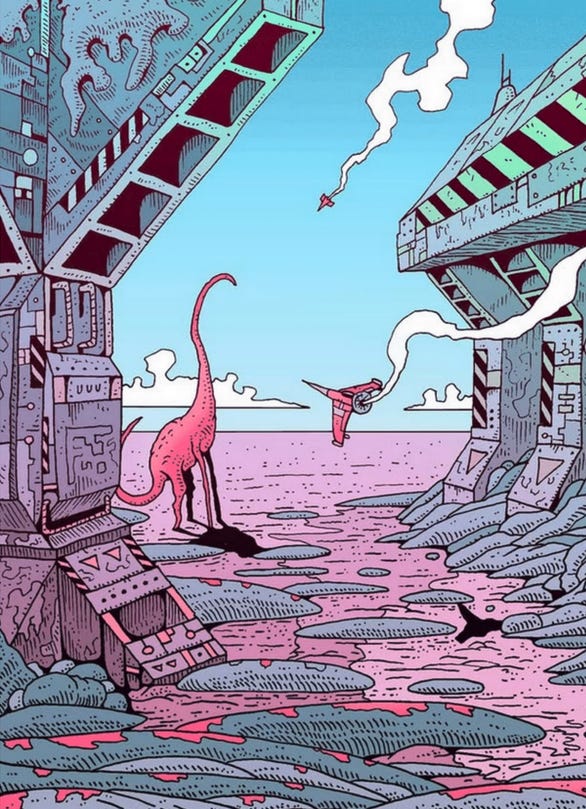
Lester: Grok?! was born from wanting to design a light system with the freedom afforded by most narrative games, but without the use of meta-currencies or other baggage that usually results in breaking away from character immersion. I also knew I wanted the game to be very modular, and capable of handling most any setting so long as it was adventure driven. The Grok?! system took about 3 total rewrites before it was distilled into its current form, getting more concise with each writing.
Once I was happy with the system, I wanted a setting that could showcase how the game could handle anything you throw at it, so I built the planet Grok that twists Dystopian Sci-Fi, High Fantasy, Science-Fantasy, Horror, Post-Apocalypse, and Cultural Discovery all into one setting. I chose to have these different types of micro-settings geographically dependent, that way when a player goes to an area, there's an expectation for what type of adventure they're likely to have.
That's how I ended up with the gonzo post-apocalyptic science-fantasy world of Grok?!!
Mario: I would like to talk about the game mechanically and what we can expect in the second edition. What makes the system work in your design philosophy, and in this second edition, will there be any adjustments or refinements to it?
Lester: Mechanically, 2e is mostly a refinement. Terminology has been tuned up for clarity, copious amounts of examples have been added, clarifications to rules, etc. The biggest mechanical change is that exploding dice are now a standard rule, whereas it was an optional rule in 1e.
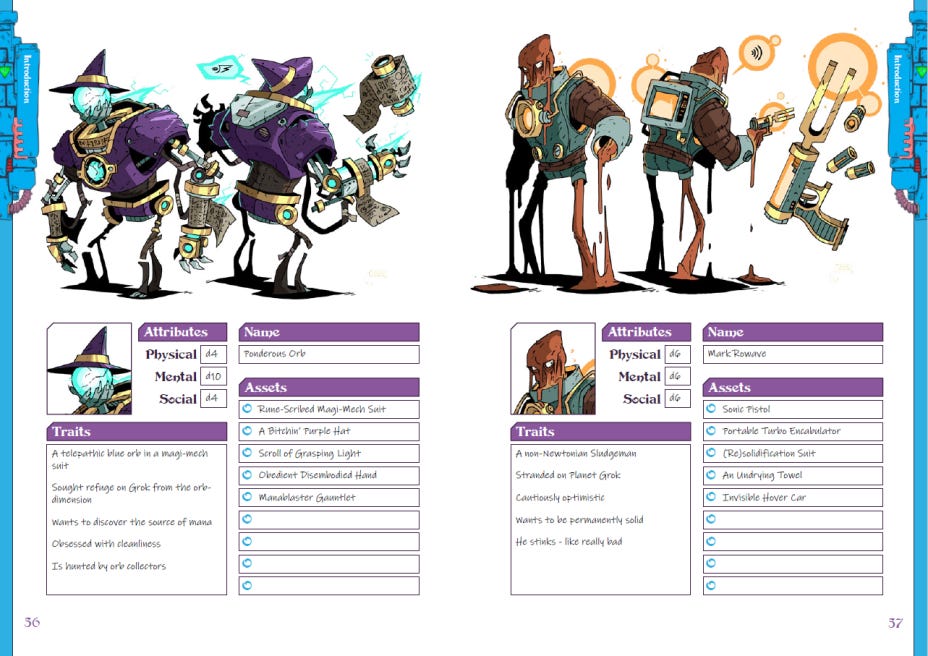
Where I think 2e is going to outshine 1e is in how much support and tools that are available. There are a LOT more tools/tables available, a full fledged campaign, expanding world into space and the center of the planet, solo play tools, 20+ pregen characters with full art, and full write-ups for each domain of the world, including example Locales to adventure.
I think the biggest element of Grok?! that ensure it aligns with my general design philosophy, is that it handles anything and everything a Character does the same way. There are no subsets of mechanics or procedures to understand or reference when they come up, everything is treated the same: Roll the relevant Attribute die type against a static target number, rolling more dice for advantage/disadvantage and taking the higher/lower result, respectively. There is some guidance for how to sequence actions when things occur simultaneously, such as in combat, but other than that it’s all handled the same.
Rules aside, trying to keep the writing as concise as possible, yet evocative and informative, can be very difficult to balance, but I’ve been keeping that balance in mind throughout development of 2e (hopefully I pulled it off!).
Mario: That all sounds amazing. I’m dying to get my hands on it and see how that system refinement turned out. On another note, I’d love to know more about the setting. You’ve already mentioned that you tried to ensure the setting includes all the necessary elements to allow the game to be played in any setting within Grok!? So, you’re saying there will be lots of new tools and plenty of tables, which everyone loves. What other changes have you worked on regarding the game’s setting?
Lester: Well one of the tools I've incorporated is a structured method of world building. Basically it's a top-down approach, organizing the world into Domains, Regions, and Locales. This approach is tied into the Solo Play rules and I follow the same structure in how Planet Grok is presented in the book.
I say that so you know what I mean when I say the Domains of the world have expanded, and 2e will include the Ether and Nether Domains.
The Ether is outer space, where awthernauts were stranded during the cataclysm. It's something between Star Wars, Alien, Red Dwarf, Spelljammer, and Waterworld (but in space).
The Nether is the eldritch megacity built on inner surface of the hollow planet. The void star at the planet's core created Lesser Ones, who in turn build the Eldritch megacity, which serves as slumbering home of Elder Ones that were summoned from the void star. It's something between Hell, R'lyeh, and New Crobuzon (Perdido Street Station).
Mario: Great! Sounds great everything you've said. One thing I loved about the first edition was the art. what will we get to see in this second edition. will you keep the style?
Lester: Thanks! Art style and vibrancy in the second edition is very much in keeping with the zine, but more polished. All of the large spreads of art are from the same artist as the zine edition, with other artists providing cover art and character art, all in the same vibrant color palette and style. I just reviewed a draft of the layout and I really can't wait to get it in my hands!
Mario: Wow, I’m really looking forward to this new edition. You had a pretty successful Kickstarter for the first one—what are your plans this time around? Do you already have a launch date for the crowdfunding campaign?
Lester: Thanks! Luckily the success of the first Kickstarter means I had some money to dump into 2e, so I'm getting 2e completely done before launching the Kickstarter. Once the layout is complete, I'm going to be pitching it to a few potential publishing/distribution partners. With any luck that'd mean I can offload the logistics side of fulfillment and tap into a larger audience, but we'll see how that goes. All that to say I'm hoping to launch this year, but that is highly dependent on if/how a partnership works out.
Mario: Wow! I can't wait to get my hands on the second edition. Thank you very much, Lester, for taking the time to talk to us.
Lester: Thank you for the time and giving me the chance to talk about my projects!!